SHINIER Documentation
🌟 SHINIER
   ███████╗██╗  ██╗██╗███╗  ██╗██╗███████╗██████╗
   ██╔════╝██║  ██║██║████╗ ██║██║██╔════╝██╔══██╗
   ███████╗███████║██║██╔██╗██║██║█████╗  ██████╔╝
   ╚════██║██╔══██║██║██║╚████║██║██╔══╝  ██╔══██╗
   ███████║██║  ██║██║██║ ╚███║██║███████╗██║  ██║
   ╚══════╝╚═╝  ╚═╝╚═╝╚═╝  ╚══╝╚═╝╚══════╝╚═╝  ╚═╝
Spectrum, Histogram, and Intensity Normalization, Equalization, and Refinement.




🎯 Overview
SHINIER is a modern Python implementation of SHINE (Spectrum, Histogram, and Intensity Normalization and Equalization), originally developed in MATLAB by Willenbockel et al., 2010. It provides precise control over luminance, contrast, histograms, and spectral content across large image sets for well-calibrated visual experiments.
Key Features and Improvements
🎨 Color Processing — New modes for color image control with modern color-space standards (Rec.601 / Rec.709 / Rec.2020).
🖼️ Dithering Support — Reduces quantization artifacts and enhances output image quality.
⚡ Optimized Performance — Efficient memory management and faster processing for large image sets (optional Cython/C++ convolution core).
🕰 Legacy Mode — Ensures full backward compatibility with MATLAB’s original SHINE toolbox.
🔢 High-Precision Arithmetic — Computations in floating-point precision rather than 8-bit integer space, minimizing rounding errors in multi-stage processing.
📦 Object-Oriented Design — Modular, extensible architecture with a clean Python API.
😀 User-Friendly CLI — Guided, prompt-based interface for users who prefer not to write code.
For detailed technical documentation (algorithms, numerical choices, and MATLAB vs Python behavior), see
documentation/documentation.md.
🚀 Quick Start
Installation
Pip Install (recommended):
pip install shinier
Note: SHINIER includes a Cython-compiled C++ extension (
_cconvolve) for faster convolution. If a C/C++ compiler is available, it will build automatically during installation, otherwise, it will fall back to a slower NumPy-based implementation.Install compilers:
macOS:
xcode-select --installLinux:
sudo apt install build-essentialWindows: Visual Studio C++ Build Tools
Install from source (development version):
git clone https://github.com/Charestlab/shinier.git
cd shinier
pip install -e ".[dev]"
Verify the install:
import shinier, sys
print("shinier version:", getattr(shinier, "__version__", "unknown"))
😀 User-friendly Interface
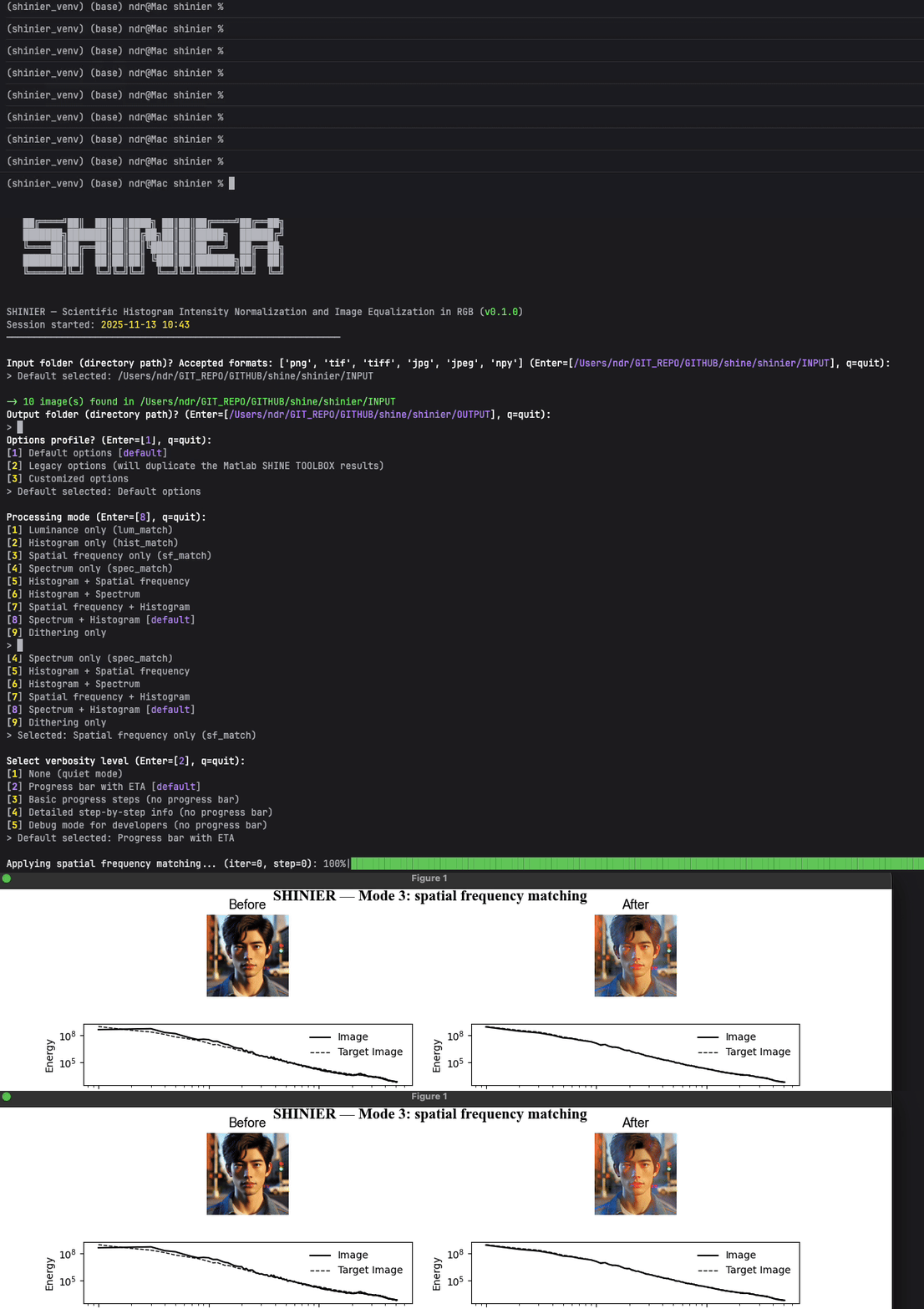
Call the following bash command to quickly start using the interactive CLI.
shinier --show_results --image_index=1
🧩 Example in Python
Run the following python code to make sure the package is running properly.
from shinier import Options, ImageDataset, ImageProcessor, utils

opt = Options(mode=3)  # Spatial frequency matching
dataset = ImageDataset(options=opt)
results = ImageProcessor(dataset=dataset, options=opt, verbose=1)
_ = utils.show_processing_overview(processor=results, img_idx=0)
Processing modes
Change the mode number (e.g. opt = Options(mode=3)) to change image processing. See details below:
Mode |
Operations |
Description |
|---|---|---|
1 |
|
Luminance (mean/std) matching |
2 |
|
Histogram matching |
3 |
|
Rotational spatial frequency matching |
4 |
|
Full 2D Fourier spectrum matching |
5 |
|
Histogram, then spatial frequency |
6 |
|
Histogram, then spectrum |
7 |
|
Spatial frequency, then histogram |
8 |
|
Spectrum, then histogram (recommended) |
9 |
|
Dithering only |
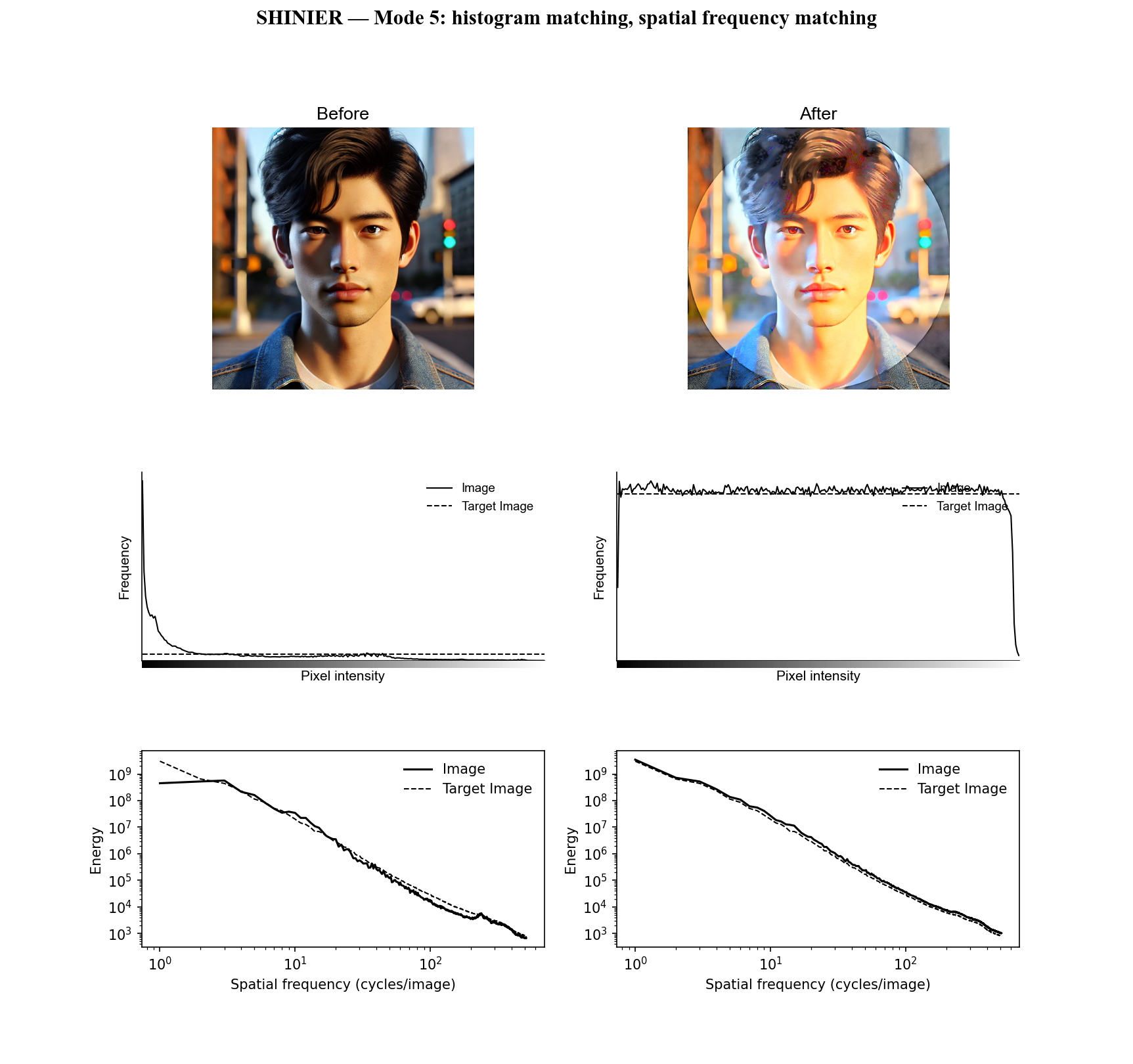
Below is an example of results obtained using mode 5 with joint histogram equalization and spatial frequency normalization.
🏛️ Technical information
See the accompanying the paper: The SHINIER the Better: An Adaptation of the SHINE Toolbox on Python
And documentation:
📚 Citing
If you use SHINIER, please cite both of these articles:
References
Salvas-Hébert, M., Dupuis-Roy, N., Landry, C., Charest, I., & Gosselin, F. (2025). The SHINIER the Better: An Adaptation of the SHINE Toolbox on Python
Willenbockel, V., Sadr, J., Fiset, D., Horne, G. O., Gosselin, F., & Tanaka, J. W. (2010). Controlling low-level image properties: The SHINE toolbox. Behavior Research Methods, 42(3), 671–684. https://doi.org/10.3758/BRM.42.3.671
🤝 Contributing
See CONTRIBUTING.md for guidelines (coding standards, tests, docs, and PR flow).
📄 License
See LICENSE for more information.
🛠️ Troubleshooting
No compiler available: install a C/C++ toolchain or proceed with the NumPy fallback (slower).
Import errors after upgrade: try pip install –upgrade pip setuptools wheel and reinstall.
Windows build issues: ensure MSVC Build Tools are installed and on PATH.
Code developed by Nicolas Dupuis-Roy and Mathias Salvas-Hébert
Version 0.2.0 - Complete technical documentation